PepsiCo’s corporate rebrand in 2025 was a parent-company reset, not a redesign of the Pepsi beverage brand. PepsiCo described the new identity as a symbol of transformation intended to make the corporate brand better reflect a portfolio of more than 500 food and drink brands, along with its focus on consumer-centricity, modernization, and pep+ (PepsiCo Newsroom). Trade coverage also framed it as the company’s first major corporate identity change in roughly 25 years (Marketing Dive) (Fast Company). That makes the project a useful example of corporate rebranding: the task was to clarify what the parent company represents without erasing the equity of the consumer brands underneath it.
- The strategic shift moves attention from “the company behind Pepsi” toward a broader food-and-beverage portfolio story.
- The corporate identity and the Pepsi consumer identity now have more clearly separated jobs.
PepsiCo’s new corporate brand identity
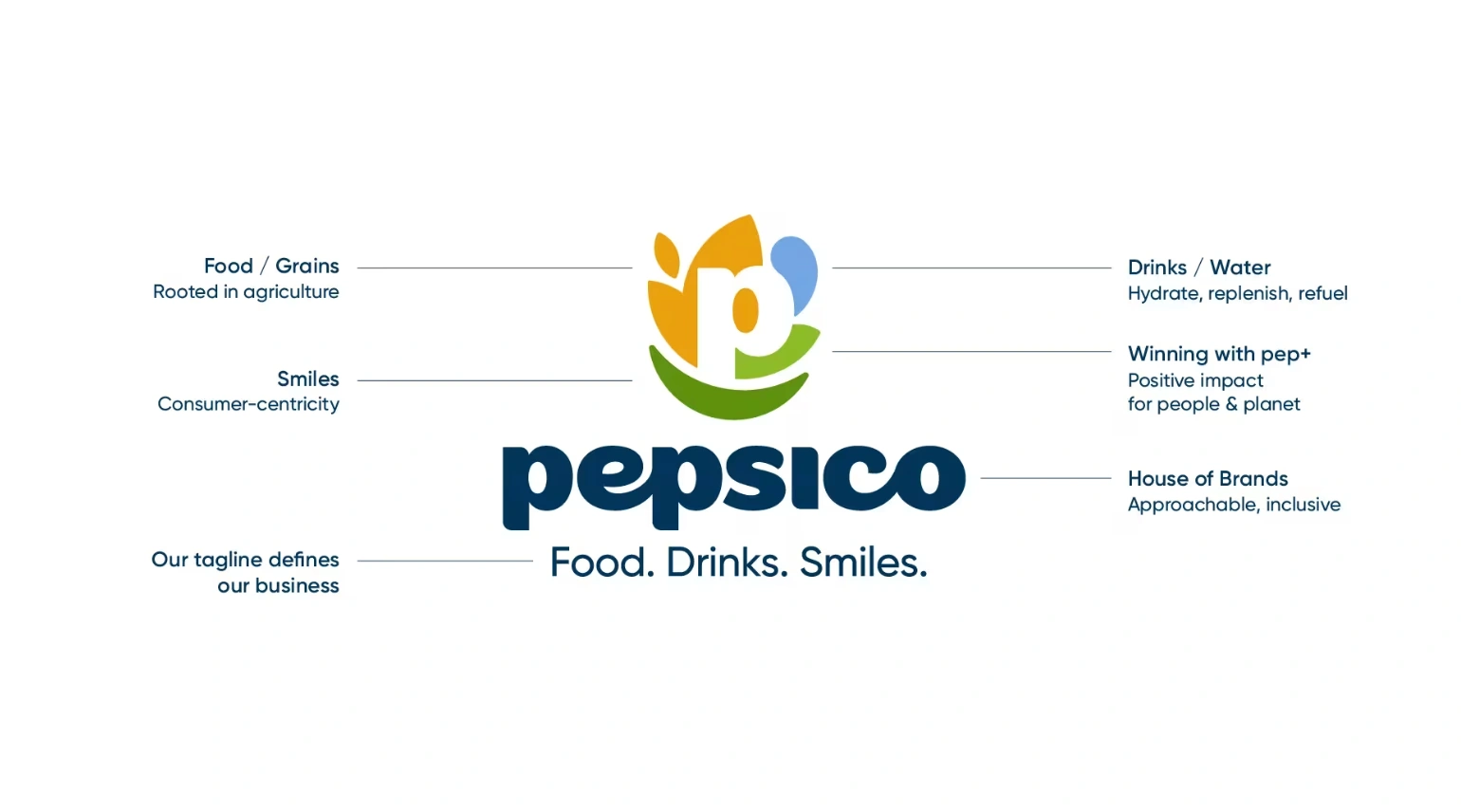
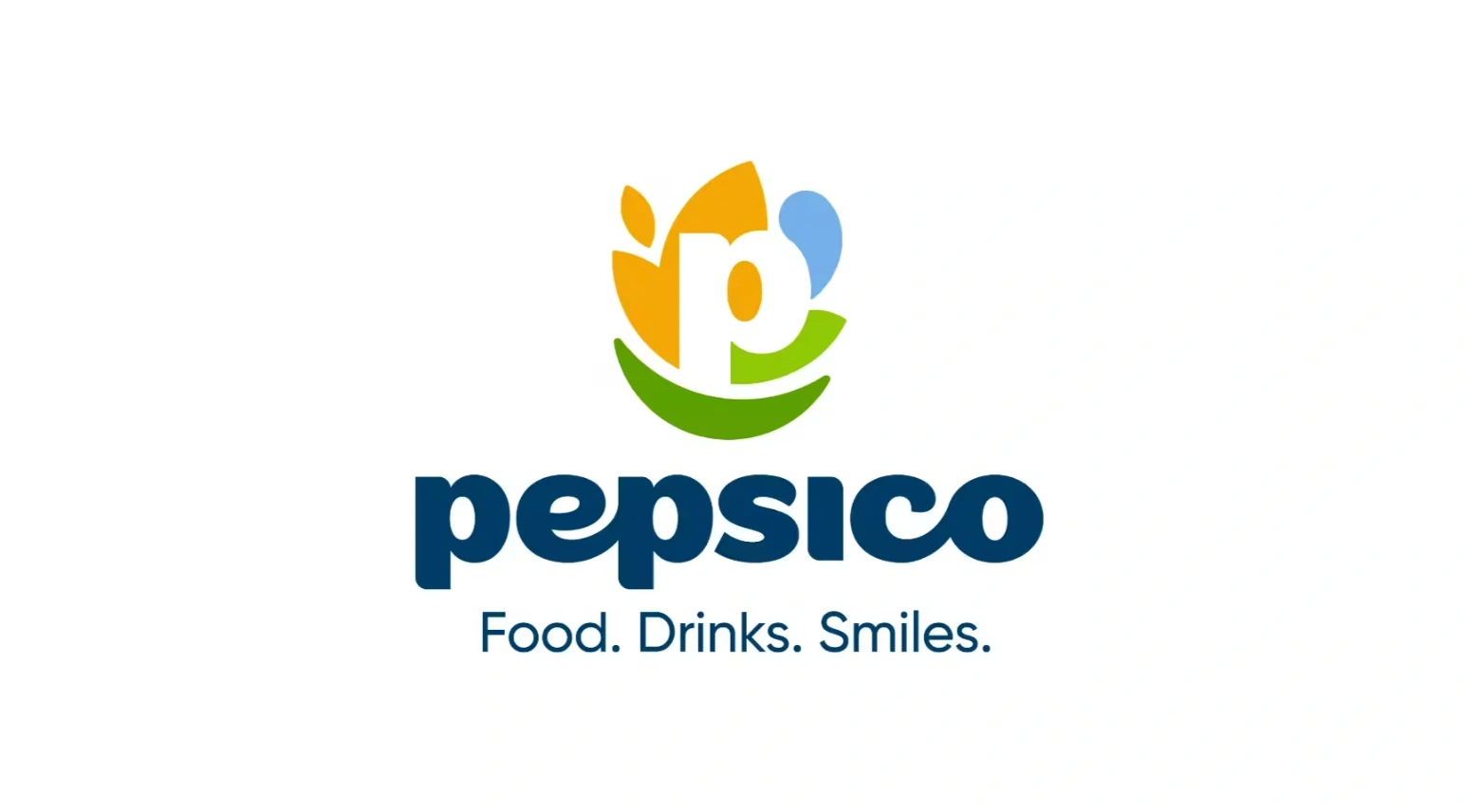
PepsiCo’s new system combines a lowercase wordmark with an emblem built around the letter “P.” The surrounding forms reference food and grains, drinks and water, positive impact, and a smile tied to the line “Food. Drinks. Smiles.” (PepsiCo Newsroom) (Marketing Dive). The palette draws from earth, water, and other natural cues, while the custom lowercase typeface is intended to feel approachable. Fast Company likewise noted how sharply the system departs from Pepsi-coded blue-and-red corporate branding (Fast Company).
The distinction between a logo and a broader visual identity design matters here. The emblem, typography, palette, layout behavior, and portfolio lockups have to work together across corporate communications instead of functioning as a single isolated mark. PepsiCo described the rollout as phased: the new system first appeared on PepsiCo.com and global social channels, with packaging, workplaces, signage, markets, and other touchpoints following over time (PepsiCo Newsroom).
Design coverage also highlighted the system’s use across multi-brand applications and its need to remain legible without competing with the consumer identities it presents (DesignRush).
Positioning shift: from product halo to enterprise promise
The most important change is strategic rather than decorative. PepsiCo wants the corporate brand to represent the breadth of the enterprise, not simply borrow recognition from Pepsi. The new emblem and “Food. Drinks. Smiles.” line create a clearer parent-company promise around food, drinks, consumer enjoyment, and the company’s stated sustainability agenda (Marketing Dive) (PepsiCo Newsroom). In brand positioning terms, the parent now has a more distinct role and audience from its flagship beverage brand.
- The parent story is broad enough to cover snacks, drinks, innovation, operations, and corporate responsibility.
- The consumer brands can continue using their own category codes and cultural personalities without carrying the full corporate narrative.
Clear separation from the Pepsi consumer refresh
Pepsi’s 2023 consumer logo update modernized the beverage brand’s own identity. The 2025 PepsiCo project serves a different audience and purpose: corporate websites, multi-brand communications, investor and policy contexts, employer communications, and other enterprise-level touchpoints. Keeping the two systems distinct reduces the risk that the parent company is visually understood as little more than an extension of its best-known soda brand (Fast Company).
- Pepsi remains a consumer brand built for category recognition and culture.
- PepsiCo needs a corporate identity capable of representing a much wider portfolio and stakeholder set.
Portfolio coherence: one roof for hundreds of brands
PepsiCo’s portfolio includes brands such as Lay’s, Gatorade, Quaker, Tostitos, Pepsi, and many regional names. The corporate identity therefore has to act as connective tissue without flattening those brands into one visual language. Coverage of the launch repeatedly emphasized the challenge of connecting hundreds of brands and markets under one corporate system (DesignRush) (PepsiCo Newsroom).
That is a classic product line naming and brand architecture problem at unusually large scale: define what belongs to the parent, what belongs to each product brand, and how the relationship stays understandable. It is especially relevant to food and beverage marketing, where packaging, retail environments, sponsorships, and local market needs can put several portfolio brands side by side.
- The corporate system creates a consistent host for multi-brand stories.
- The product brands retain the distinctive assets needed for their own categories and audiences.
Corporate voice for modern stakeholders
A contemporary corporate identity can make the parent company easier to recognize in contexts where a single product brand is too narrow. PepsiCo’s own launch messaging connects the identity to modernization, consumer-centricity, portfolio breadth, and the company’s future direction (PepsiCo Newsroom). The stronger claim is not that a new logo automatically changes reputation, but that a clearer corporate system gives PepsiCo a more coherent way to communicate with investors, partners, employees, policymakers, and other non-consumer audiences.
- The parent brand can carry enterprise-level topics without making every message look like a Pepsi advertisement.
- A consistent system makes multi-brand corporate communications easier to recognize across formats.
pep+ and sustainability in the identity
PepsiCo explicitly connects the new look to pep+, its sustainability agenda, and describes the surrounding logo forms as references to food, water, and positive impact. That makes sustainability part of the visual story PepsiCo wants the corporate brand to communicate (PepsiCo Newsroom) (Fast Company). It is better read as a stated corporate positioning choice than as proof that the identity itself delivers environmental outcomes.
- The design gives pep+ a visible place in the parent-company narrative.
- The credibility of that story still depends on the company’s underlying operations and reporting, not the symbol alone.
Timing context: a 25-year corporate reset
The timing also matters. PepsiCo said its corporate brand had remained essentially unchanged for nearly 25 years, while the company expanded to more than 500 brands and a much broader global footprint (PepsiCo Newsroom). Marketing Dive and Fast Company both framed the rebrand against a business environment in which PepsiCo was trying to communicate a wider portfolio and respond to changing expectations around health, growth, and corporate transformation (Marketing Dive) (Fast Company).
- The identity catches the corporate brand up with a business that changed substantially since the early 2000s.
- The phased rollout gives the system time to move through many markets and physical touchpoints rather than treating launch day as completion.
Global scalability: consistency without sameness
A corporate identity at PepsiCo’s scale has to work across regions, languages, corporate channels, workplaces, packaging, and settings where multiple consumer brands appear together. The launch materials emphasize simplification, modernization, and a phased global rollout (PepsiCo Newsroom) (DesignRush). For other organizations, the transferable lesson is to build a recognizable corporate brand system with rules strong enough to create recognition without forcing every market or product into identical expression. A branding agency can support that translation from corporate strategy into positioning, identity rules, and practical applications, without implying involvement in PepsiCo’s work.
- Repeatable corporate codes reduce ambiguity when many brands share a stage.
- Local and product-level expression can remain flexible inside a clearly defined parent system.
Competitive signaling beyond beverage-company optics
By separating the corporate identity from Pepsi’s consumer aesthetics, PepsiCo creates more room to discuss snacks, hydration, nutrition, technology, operations, and sustainability without every corporate message defaulting visually to cola. Fast Company and Marketing Dive both connected the redesign to PepsiCo’s effort to broaden how people understand the company beyond its namesake soda (Fast Company) (Marketing Dive).
- The parent company has more freedom to frame a diversified portfolio.
- Consumer brands can continue competing on their own category-specific equities.
FAQ
Is this the same as Pepsi’s 2023 logo refresh?
No. Pepsi’s 2023 update changed the consumer beverage brand. The 2025 project is the corporate PepsiCo identity used to represent the parent company and its portfolio.
What does the new emblem signal strategically?
PepsiCo says the forms around the “P” represent food and grains, drinks and water, positive impact, and a smile. Together they are intended to communicate the breadth of the company and its consumer-focused corporate story.
Why undertake a parent-brand overhaul now?
PepsiCo said the corporate identity had remained essentially unchanged for nearly 25 years while the portfolio and company had expanded substantially. The rebrand brings the parent-company story closer to the scale and mix of the current business.
How does this affect portfolio brands?
The corporate system provides a common parent identity for multi-brand and enterprise contexts. It does not replace the individual visual identities of brands such as Pepsi, Lay’s, or Gatorade.
Was the new identity rolled out everywhere at launch?
No. PepsiCo said it started with PepsiCo.com and its global social channels, then planned to phase the identity across markets, packaging, workplaces, signage, and other touchpoints over time.
A clearer face for a bigger company
PepsiCo’s 2025 corporate rebrand is most useful as a brand-architecture lesson. The parent needed an identity that could speak for a much broader food-and-beverage company while keeping the consumer brands distinct. The result separates PepsiCo more clearly from Pepsi, gives portfolio breadth a visible role, and creates a system designed to expand across corporate touchpoints over time.
For organizations facing a similar parent-brand or portfolio challenge, Brand Vision can help connect strategy, architecture, and visual identity into one coherent system. To explore the fit, discuss a corporate brand project with our team.