
From Drama To Co-Parenting Brand: How Celebrity Divorces Rewrote The Breakup Script
Updated on
Published on
When the news broke in early 2025 that Nicole Kidman and Keith Urban were ending their marriage, the public braced for impact. For nearly two decades, they had been the industry standard for red-carpet romance. Yet, instead of tabloid leaks and paparazzi chases, the world received a calm, coordinated press release. It arrived with a pre-signed parenting plan and a narrative so polished it could have been a film script. This was not a scandal; it was a scheduled programming update.
The Kidman-Urban announcement joined a wave of 2025 splits that cemented a new era in Hollywood. Gone are the days of the War of the Roses. In its place is the era of the "successful separation," where the end of a marriage is framed not as a failure, but as a strategic pivot to a new kind of family unit. This shift is not accidental. It is a calculated move where personal brands, sponsor contracts, and family law intersect to protect the asset that matters most: the celebrity’s reputation.
Off camera, those polished joint statements sit on top of very real court paperwork. Northwest Family Law sees the gap between public narrative and private files every day. As the legal team there put it, "Celebrity or not, divorce is still one of the hardest chapters a person can live through, and our work is about turning that pain into a plan for a better future for the whole family." That contrast between glossy messaging and grounded legal work is exactly what shapes modern breakup storytelling.

The standard script: “We remain friends and committed co-parents”
If you read enough celebrity divorce announcements, you start to see the template. The wording rarely varies. There is always an insistence that the split is "amicable," a promise to "remain the best of friends," and a declaration that "our children are our priority." In 2025, we saw this verbatim in statements from major streaming stars and music icons alike.
This uniformity serves a specific business purpose. For a celebrity, a messy divorce is a liability.
Brands that pay millions for endorsements want stability, not court drama. When a star announces a split with "love and respect," they are signaling to advertisers that they remain a safe investment. They are protecting their "family-friendly" label, even as the family structure changes.
The 2025 Breakup Bingo
- "We have lovingly chosen to separate."
- "We ask for privacy for the sake of our children."
- "We transition now from partners to friends."
- "We move forward with mutual respect."
These phrases act as a shield. They prevent speculation and allow the couple to control the timeline. By the time the public hears the news, the legal heavy lifting is often already done, hidden behind a wall of non-disclosure agreements and carefully drafted PR copy.
With the public statement issued, the strategy shifts to maintaining that image through daily content.
Co-parenting as content: Instagram grids, reality TV and podcast confessions
The narrative of the "happy divorce" does not end with the press release. It continues on social media. Stars have realized that co-parenting is a relatable, high-engagement content vertical. Christina Haack (formerly Hall) has spent years documenting her blended family life across various reality shows and Instagram posts. The message is clear: we are modern, we are resilient, and we are putting the kids first.
For fans, these images of ex-spouses reuniting for graduation photos or soccer games offer reassurance. It supports a personal brand built on emotional intelligence. It suggests that the celebrity is mature enough to rise above petty grievances. This approach keeps both ex-partners relevant. Instead of one person vanishing from the spotlight, they both remain characters in an ongoing family saga.
This content strategy also opens new revenue streams. Podcasts about blended families, books on "conscious co-parenting," and reality storylines about dating after divorce drive massive engagement. The breakup becomes the launchpad for the next phase of their career.
However, not every split follows the script, and when the facade cracks, it reveals the tension underneath.
When the split is not so neat: public conflict and “nightmare” co-parenting
While the "amicable" narrative is the goal, reality often interferes. We saw this clearly with Bravo stars like Lala Kent. Despite the initial attempts at privacy, the situation with her ex, Randall Emmett, devolved.
When these conflicts spill into the open, they usually involve high-stakes legal maneuverings that PR teams cannot suppress. Restraining orders, custody investigations, or allegations of financial misconduct change what lawyers allow their clients to say. In these cases, the silence is not about dignity; it is about legal strategy.
Even when a star sounds raw and unfiltered in an interview, the public is likely hearing a version of events vetted by counsel. If a celebrity mentions they are "fighting for their kids," it often signals a specific dispute over physical custody or decision-making power. The "nightmare" soundbites are compelling, but they are often just the tip of a much larger, colder legal iceberg.
Behind the Instagram captions: what the law actually requires
To understand what is really happening, you have to look past the Instagram caption and toward the courthouse. When Kidman and Urban filed their documents in 2025, the "love and respect" they cited was backed by a rigorous legal framework.
In family law, "co-parenting" is not just a vibe; it is a contract. It involves a parenting plan that dictates where the children sleep every night of the year. It outlines who holds the passports, who pays for private school, and how they handle medical decisions.
Even the most relaxed joint statement usually sits on top of a precise schedule. The court requires certainty. A judge does not care if the parents are "best friends"; the judge cares about who picks up the child from school on Tuesdays.
How family lawyers read a celebrity breakup announcement
Legal experts read these public statements differently than fans do.
They look for the subtext.
- "Primary Residence": If a statement hints that the children will stay in one location while the parents travel, it suggests a specific custody arrangement, often where one parent has the majority of parenting time.
- "Co-parenting": This term implies shared decision-making. It means both parents likely retain the right to approve major life choices, regardless of where the children sleep.
- Silence on Money: If the statement completely ignores financial details, it usually means a prenuptial agreement settled the assets long before the separation, or that a private settlement was reached in mediation to avoid a public docket.
When a statement emphasizes "stability for the children," it is often a sign that the parenting schedule has already been signed, sealed, and delivered.
Why the “amicable divorce” narrative resonates with fans
Why do we buy into these polished narratives? Part of it is the parasocial relationship. Fans spend years investing in a celebrity couple. When they split, it feels like a personal loss. A friendly breakup softens the blow. It allows the fan to keep liking both stars without choosing sides.
There is also a generational shift. Audiences today are more aware of mental health and the impact of trauma. Seeing stars like Ethan Hawke discuss how they kept their divorce private to protect their children resonates with a public that values emotional health. We want to believe that it is possible to end a relationship without destroying a family. The celebrity "good divorce" offers a model of hope, even if it is unattainable for most.
This leads to the inevitable comparison between Hollywood endings and real-world beginnings.
What regular couples should and should not copy from Hollywood splits
While the private jet lifestyle is out of reach, some aspects of the celebrity divorce strategy are worth emulating. However, it is vital to know the difference between a PR move and a practical tool.
Table: The Hollywood Divorce vs. The Real World
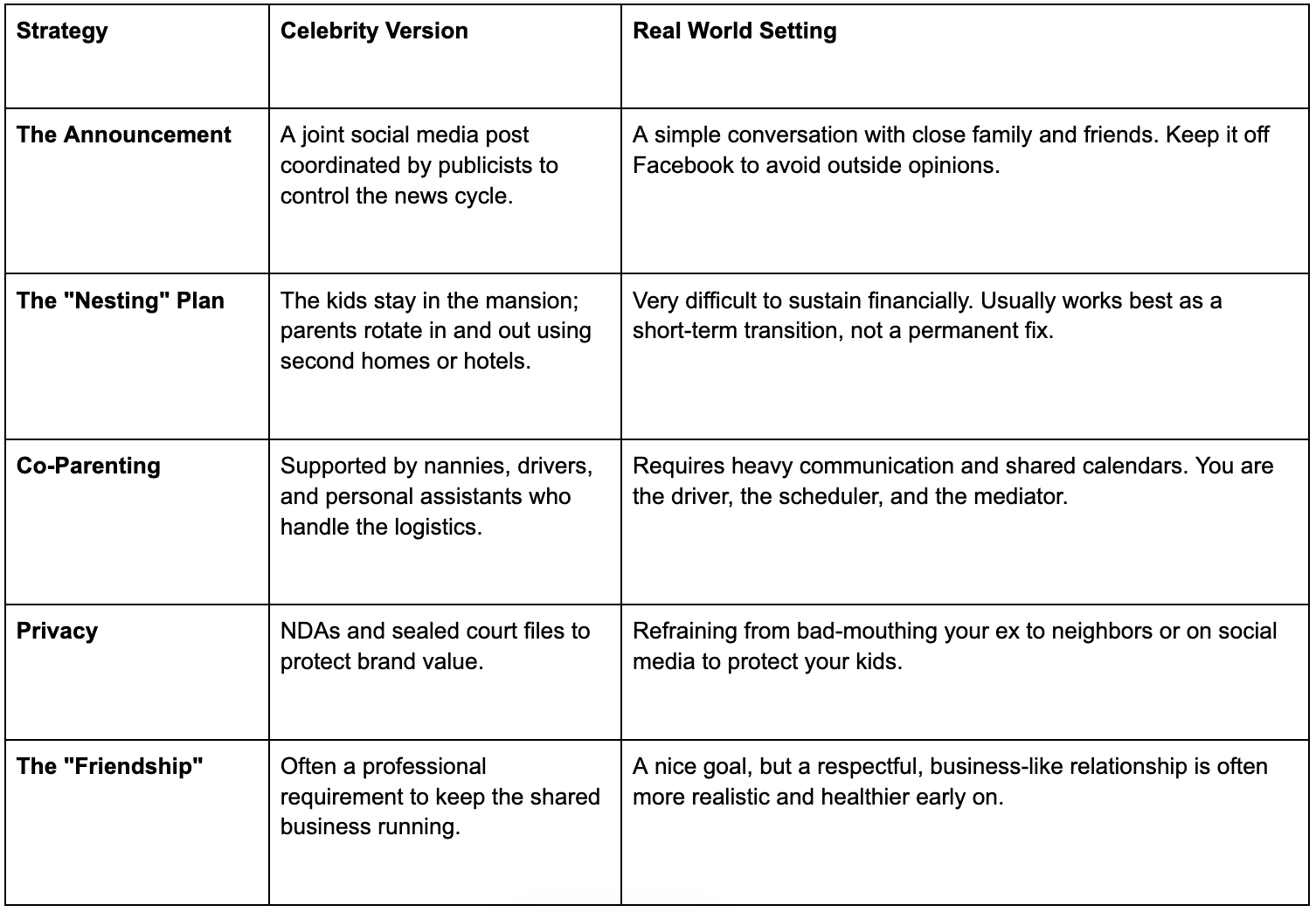
The biggest mistake regular couples make is trying to replicate the "instant friendship" seen in magazines. Celebrities have teams of people to buffer the friction. In a normal household, creating a respectful distance is often healthier than trying to force a "best friends" dynamic immediately.
Practical takeaways for non-famous families
The most valuable lesson from the 2025 celebrity breakup wave is the value of a plan. The "Kidman-Urban" style filing shows that having the details sorted out before going public reduces chaos. Regular families can copy the idea of clear boundaries. Agreements on social media privacy for the kids, defined holiday schedules, and a commitment to keeping legal talks away from the dinner table are strategies that work for everyone.
The 'Hollywood' elements to ignore
On the flip side, ignore the pressure to look perfect. You do not need to post a selfie with your ex to prove you are a good parent. You do not need to go on vacation together. Celebrity exes often vacation together because they have enough money to stay in separate wings of a resort. For normal families, firm boundaries usually serve the children better than performed intimacy.

Co-parenting as a brand story for celebrities and companies
Ultimately, the shift to the "amicable split" is a business decision. In 2025, a celebrity’s marketability depends on their likability. A star who is seen as a "good ex" and a dedicated parent appeals to a wider demographic.
Casting directors and brand managers watch these transitions closely. A celebrity who handles a divorce with grace proves they are reliable and level-headed. They become attractive partners for campaigns centered on modern families, home goods, and wellness. We are already seeing major brands partner with newly single stars to promote products for "blended homes" or "fresh starts."
The breakup script has been rewritten because the audience changed. We no longer want just the drama; we want the recovery. By turning a potential PR disaster into a story about resilience and co-parenting, celebrities are not just saving their families—they are securing their futures.