
In 2026, immersive marketing is increasingly being evaluated as more than spectacle. Leadership teams are asking a sharper question than “Did people like it?” They want to know whether experiential marketing can support preference, sales conversations, useful content, and measurable follow-up after the activation ends.
That is where experiential brand worlds can earn their place. Done well, they create lived proof and structured signals that digital teams can use, from reusable content to first-party insight that strengthens follow-up. Sensory marketing can make an experience more distinctive and memorable when the cues reinforce the same idea instead of competing for attention.
The stronger approach is to treat immersive marketing as a system rather than a one-off build. That system can connect multisensory branding, brand experience design, and measurable outcomes across physical and digital touchpoints. For a regional program, a branding agency in Miami can support local execution without changing the core brand system.
At a Glance
Immersive marketing works when the experience is designed around one clear behaviour change. Experiential marketing becomes more credible when it produces pipeline signals, not just attendance. Sensory marketing and multisensory branding matter most when they are coherent and restrained.
Key takeaways for decision makers:
- Experiential brand worlds should be planned like products, with a roadmap and governance
- Brand experience design needs to support comfort, accessibility, and real human flow
- Phygital loops can connect entertainment marketing activations with measurable follow-up paths
- Measurement is moving beyond attendance and scans toward engagement quality, follow-up, and contribution to commercial outcomes (Event Marketer)
- B2B and B2C can share the same immersive marketing architecture, with different pacing and proof
Why Immersive Marketing Matters Now
Buyer trust is harder to earn in crowded markets. Digital channels remain central, but some decisions benefit from physical demonstration, conversation, or hands-on proof. Experiential marketing can add that context when the experience is designed around a clear question or behaviour.
Immersive marketing also solves an internal problem. It gives sales, marketing, and product a shared story they can point to. That shared story reduces inconsistency across decks, demos, and follow-up. In many organisations, that alignment is worth as much as the event itself.
Immersive programs are easier to continue and measure when they connect to the digital journey. A high-performing site, clear information architecture, and fast landing pages can help turn interest into an appropriate next step. That is why teams often strengthen the foundation with a web design partner before scaling experiential brand worlds across markets.
The data side is also improving. Event teams are increasingly expected to prove impact, and measurement methods are expanding beyond scans and surveys toward richer engagement signals (Event Marketer). That shift supports a more mature model for immersive marketing in 2026.

What an Experiential Brand World Is in 2026
An experiential brand world is a designed environment that expresses positioning through narrative, interaction, and sensory cues. It can be a flagship store, a pop-up, a mobile tour, a conference build, a customer centre, or a hybrid format that connects online and in-person touchpoints. The useful test is whether the experience has a clear purpose, can be repeated or adapted, and can be evaluated against agreed outcomes.
An experiential program becomes fragile when the “world” is treated like décor. People may take photos without understanding what is different about the brand. A stronger environment makes the value proposition easier to grasp through interaction, demonstration, or guided storytelling.
In 2026, experiential brand worlds should also respect attention. Visitors are often overwhelmed, time-constrained, and sceptical. Multisensory branding should support focus, not compete for it. Brand experience design is the discipline that keeps the experience calm, clear, and useful.
The Five Layer Model
A layered model can help teams plan immersive marketing without treating the build itself as the strategy.
- Narrative layer: the one idea visitors should carry out
- Proof layer: what the experience proves, not what it claims
- Interaction layer: what visitors do, not what they look at
- Sensory layer: how sensory marketing reinforces meaning across senses
- Measurement layer: how the experience produces pipeline signals
This model also protects teams from overbuilding. Experiential brand worlds do not need more features. They need more coherence. Multisensory branding should repeat a small set of cues that align with the narrative, rather than changing tone in every zone.
If your narrative is not clear, pause before you build. Many teams start by clarifying positioning and message hierarchy with a branding team so experiential brand activations have a stable foundation.
Where Sensory Marketing Fits
Sensory marketing is not about stimulation for its own sake. It is about using cues that support meaning. Research has found relationships between sensory brand experience and loyalty-related outcomes, including pathways through satisfaction and attachment (ScienceDirect). That does not mean a scent, sound, or material automatically produces loyalty, but it does support treating sensory choices as part of the broader experience.
Multisensory branding works best when it is coherent. If your brand promise is precision, the space should sound, feel, and behave with precision. If your promise is warmth, the materials, lighting, and pacing should feel warm, not just the copy.
In practical terms, sensory marketing should be treated as a palette. You select cues and intensities, define what is off limits, and document it so experiential brand worlds stay consistent across markets.
The Sensory Marketing Playbook: Designing for Five Senses
The goal of sensory marketing is to make your story easier to remember. That requires restraint. When too many cues compete, the visitor remembers the noise rather than the meaning. Multisensory branding is strongest when each sense supports the same idea at the same volume.
One optional planning heuristic is to choose two primary senses and one supporting sense per zone. The point is not the number itself. It is to limit competing cues so the experience stays focused and can be delivered consistently during real traffic.
Below is a practical sensory marketing playbook for experiential marketing teams building experiential brand worlds that need to scale.
Sight
Sight sets hierarchy. Visitors should know where to go and what to do within seconds. Brand experience design uses sight to reduce friction, not to overwhelm.
In immersive marketing, visuals should also support proof. Product details, material choices, and demonstration zones should be easy to scan. Multisensory branding should use colour and contrast with intention, then let touch and sound deepen the memory.
Ways to apply sight in experiential brand activations:
- Create one clear focal point per zone that signals the main action
- Use lighting to guide flow and dwell, not just to add drama
- Reduce clutter so product and people become the centre of attention
Sound
Sound controls pace and perceived quality. It affects conversation, comprehension, and comfort. Sensory marketing often fails here because teams either ignore sound or treat it like a nightclub problem.
Immersive marketing should map sound zones. Quiet zones support learning and sales conversations. Higher energy zones can support emotion and momentum, but they still need clarity for staff and visitors. Multisensory branding should also include voice guidelines for hosts and demos, because tone is part of the soundscape.
Ways to apply sound in experiential marketing:
- Build a simple sound map with quiet and active zones
- Use audio cues to mark transitions, like arrivals or reveals
- Ensure staff can be heard without strain, even when the space is busy
Scent and Air
Scent can become a signature, but it needs operational discipline because airflow, crowd density, material off-gassing, and individual sensitivity can all change how it is perceived.
Multisensory branding should also respect sensitivity. A strong scent can reduce comfort for some visitors. Brand experience design should consider scent-free areas, clear circulation, and an easy path around scent-heavy interactions.
Ways to use scent and air in experiential brand worlds:
- Use scent as an arrival cue or reset cue, not a constant blanket
- Test scent intensity in real traffic conditions, not in a quiet build day
- Plan ventilation and circulation so comfort stays consistent throughout the day
Touch and Materials
Touch is where claims become real. If you position around quality, the experience must feel quality in the details people touch. This includes product, fixtures, seating, packaging, and interaction props.
Immersive marketing often gets the visuals right and the touch wrong. Visitors notice. Multisensory branding should define a small set of materials that represent the brand and repeat them consistently. Brand experience design should also ensure touchpoints are durable under real use.
Ways to apply touch in experiential brand activations:
- Choose signature materials that match your positioning and repeat them
- Design hands-on proof moments with pop-ups that teach value without heavy selling
- Avoid fragile interaction elements that degrade quickly and undermine trust
Taste and Ritual
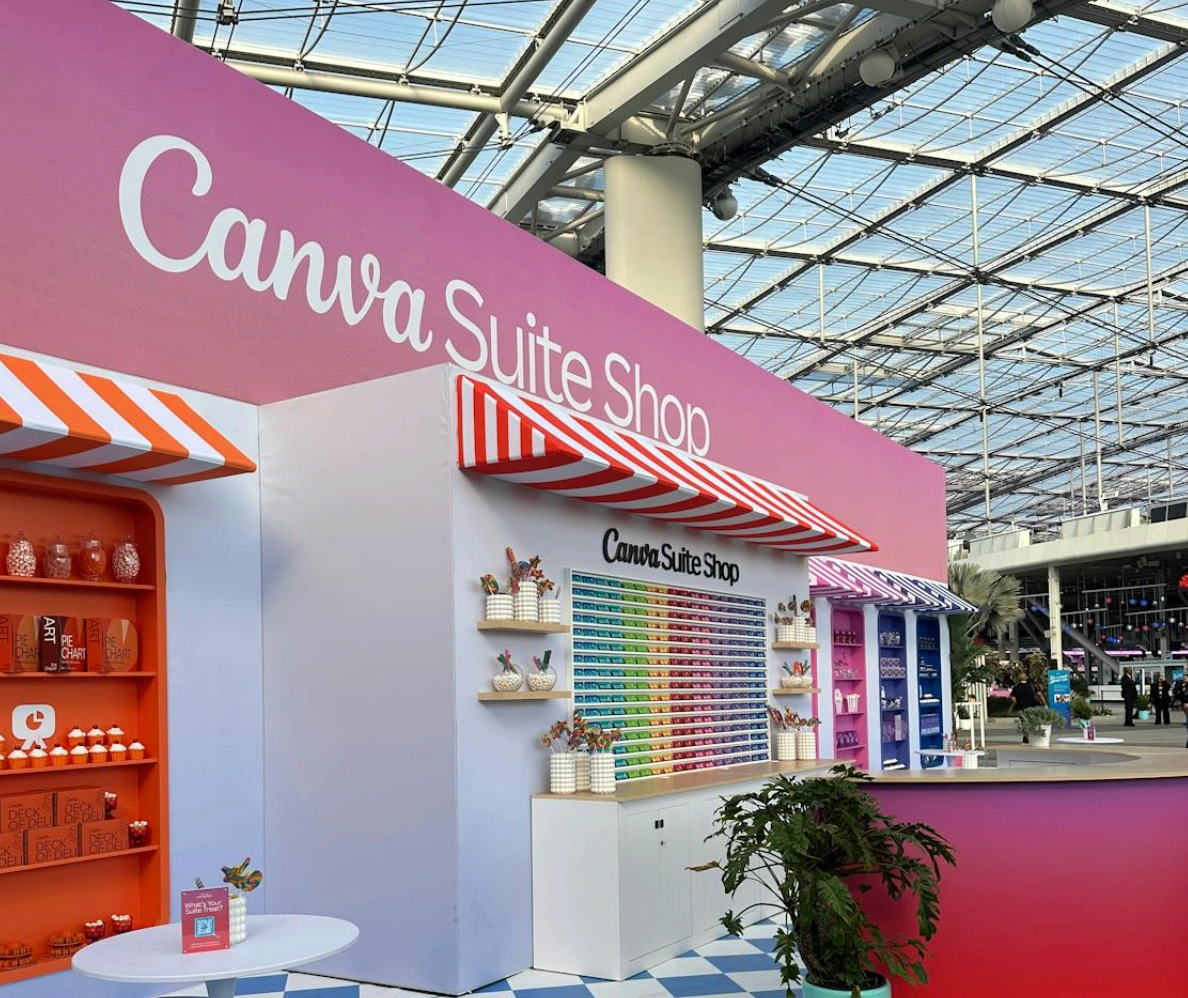
Taste is category dependent, while ritual can be useful across many formats because it turns a visitor from observer to participant. For food and beverage marketing, tasting can itself become the proof moment; in other categories, the ritual may be a guided comparison, personalization step, or product demonstration.
If taste is relevant, it should reinforce meaning. If it is not, create a ritual that still produces a meaningful outcome, such as a personalised result, a comparison, or a guided build. Multisensory branding becomes stronger when ritual repeats across cities and teams.
Ways to build ritual into experiential brand worlds:
- Create a two to five-minute guided ritual that teaches one key truth
- Ensure the ritual produces a takeaway, not just a moment
- Make the ritual easy to staff consistently, even during high traffic
Experiential Marketing Design That Works in Real Spaces
The difference between “beautiful build” and “useful experience” is architecture. Brand experience design shapes flow, sets expectations, and reduces the friction that makes people leave early. Pop-up designs can be easily assembled and disassembled while still serving the same purpose.
Experiential marketing should be designed for real behaviour. People arrive late. They get distracted. They come with friends. They ask basic questions. Immersive marketing teams need to plan for that reality rather than building for an ideal visitor.
This is also where digital matters. Visitors will often check your site during or after the experience. If the site is slow, confusing, or inconsistent, the memory breaks. That is why aligning experiential brand worlds with clear digital UX is a core part of brand experience design, and why teams often involve a UI UX design agency in the planning stage.
Journey Mapping for Dwell, Not Clicks
Traditional funnel thinking often maps steps like clicks. In experiential marketing, dwell can be a useful operational signal because it shows where people choose to spend time. It should not be treated as proof of learning, preference, or purchase intent on its own.
A practical map includes three moments: arrival, peak, and exit. Arrival should establish context quickly. Peak proof should be the most hands-on or emotionally resonant interaction. Exit should provide a simple next step that respects intent, whether that is booking, trial, or stakeholder kit.
Ways to map immersive marketing journeys:
- Design one primary action per zone, not multiple competing actions
- Place proof where dwell is likely, not where it looks best on a floor plan
- Build a calm exit path that offers a clear next step without pressure
Accessibility, Comfort, and Flow
Accessibility should be part of the experience from the start, not added after the build. Navigation, sound levels, visual intensity, seating, queues, and staff visibility all affect whether more people can participate comfortably.
Brand experience design should plan for clear signage, readable type, seating, queue comfort, and staff visibility. Sensory marketing should also be inclusive, with options that reduce overload. Multisensory branding should support clarity and calm, not overstimulation.
If you are building experiences across cities, document the baseline that should remain consistent while allowing local adaptation. For Canadian programs, Brand Vision locations in Canada provide regional context, while teams coordinating work locally can review Brand Vision in Toronto.
For travel and hospitality marketing, the same system can help a property or destination carry sensory cues from arrival through the digital follow-up without forcing every location into an identical experience.
Immersive Marketing Meets Digital: Phygital Loops That Convert
Phygital is often misunderstood as “add a screen.” The practical meaning is simpler. The experience should start before someone arrives and continue after they leave. That continuity is what turns experiential marketing into a growth system rather than an isolated moment.
Immersive marketing becomes easier to evaluate when the experience produces a structured follow-up. That includes fast landing pages, clear consent, and relevant next steps. Experiential brand activations should avoid sending every participant into the same follow-up regardless of intent or behaviour.
This is where multisensory branding and digital design meet. The physical story sets emotion and meaning. The digital system captures the signal and carries it forward. Experiential brand worlds should be designed with that loop in mind from the first floor plan.
Mobile as Remote Control
Mobile should support the experience, not distract from it. The most effective pattern is to use mobile for three things: identity, preference, and next step.
Identity can be a simple check-in or badge. Preference can be a short choice that personalises content or follow up. The next step can be a booking link, stakeholder kit request, or trial path. Brand experience design should keep mobile interactions short, fast, and forgiving of poor connectivity.
Ways to use mobile in immersive marketing:
- Provide one clean landing page that loads quickly on weak networks
- Use one short preference question to personalise the journey
- Offer a next step that fits the visitor’s role and buying stage
Content Capture by Design
Content can be an important secondary output of experiential marketing when it is planned without turning the experience into a photo set. The strongest capture points are usually moments that would still matter even if nobody posted them.
Design for content by creating two or three “capture points” that still feel authentic. These might be a reveal, a hands-on proof ritual, or a personalization outcome. Multisensory branding strengthens content because the experience feels more real and less like an ad. For consumer-facing activations, an AR photo booth such as Banuba’s can turn one of those capture points into a branded, interactive moment that supports content creation and post-event follow-up.
Ways to plan content capture in experiential brand activations:
- Build a few visually clean moments with good lighting and space for filming
- Ensure staff prompts encourage participation without forcing sharing
- Prepare post-event edits and landing pages so content drives measurable action

Experiential Brand Activations You Can Learn From
Examples are very useful when you study the system behind them. Strong immersive marketing uses narrative, sensory marketing, and measurement together. It treats experiential marketing as an operating model, not just creative production.
The examples below illustrate patterns that translate across industries. They show how experiential brand worlds can teach product value, deepen emotional memory, and create measurable follow-up signals without losing craft.
Starbucks Reserve as a Multi-Sensory System
The Starbucks Reserve Roastery in Shanghai is a useful reference point because it was designed as a destination, not a store. Starbucks described it as a multi-sensory coffee experience and highlighted interactive elements that bring the bean-to-cup story to life (Starbucks Investor Relations). That framing matters because it shows immersive marketing tied directly to narrative and product education.
The experience also reinforces multisensory branding through materials, aroma, visual theatre, and ritual. It creates reasons to dwell and reasons to return. The company’s own Reserve site describes the Shanghai Roastery as one of its most theatrical experiences (Starbucks Reserve).
What this pattern teaches experiential marketing teams:
- Build one core ritual that teaches value and encourages dwell
- Use sensory marketing to reinforce meaning, not to create noise
- Design the environment so purchase feels like the natural next chapter
Sport and Product Storytelling in Flagship Retail
Flagship retail continues to evolve toward immersive marketing because it forces proof into physical reality. When done well, visitors understand product performance through interaction, not persuasion. That is brand experience design doing its job.
Recent retail coverage highlights how brands are expanding beyond traditional store formats to create immersive spaces focused on experience (Forbes). The commercial lesson is not “build bigger.” It is “build clearer.” The same principle appears in fashion marketing strategies, where retail environment, product story, and cultural context need to reinforce one another.
What this pattern teaches for experiential brand activations:
- Replace signage with guided proof moments wherever possible
- Use multisensory branding to signal quality, calm, and confidence
- Ensure the post-visit digital journey matches the in-person clarity
B2B Ready Immersive Marketing Without the Gimmicks
B2B teams often assume experiential marketing is a consumer play. In practice, a B2B marketing program can also use immersive formats when buyers need demonstrations, stakeholder alignment, or hands-on proof. The experience should be designed around those decision needs rather than consumer-style spectacle.
B2B does not need theatrics. It needs clarity. Sensory marketing in B2B should support focus and trust. Multisensory branding should be subtle, consistent, and aligned with credibility. Brand experience design should prioritise comfortable conversation zones, clear demos, and a clean follow-up system.
What this pattern looks like in practice:
- A guided product lab where visitors test key capabilities hands-on
- A workshop format that produces a tailored output for the visitor’s team
- A follow-up kit that routes stakeholders into the right content and next steps
Measurement: How Immersive Marketing Can Influence Revenue
The measurement conversation has matured. Leadership increasingly expects experiential marketing to connect activity with business outcomes, and teams are responding with more disciplined KPIs and attribution approaches. Industry reporting describes an evolving measurement landscape where refined metrics and new tools are changing how experience builders evaluate impact (Event Marketer).
The most important shift is moving away from vanity outcomes. Attendance alone does not prove value. Scans alone do not prove value. Immersive marketing needs metrics that map to pipeline, velocity, and influence.
B2B event benchmarks also show that events remain an important channel for many teams, which increases the pressure to measure them consistently. Bizzabo’s 2025 benchmark material draws on a large sample of event professionals and organizations (Bizzabo).
Measurement also needs to account for experience quality. Research on sensory brand experience supports examining satisfaction and attachment alongside immediate conversion metrics, while keeping those measures distinct from direct revenue attribution (ScienceDirect).
KPIs That Map to Pipeline
A practical KPI set for experiential brand activations should connect behaviour to business. Keep it small. Make it consistent. Define thresholds that separate signal from noise.
Useful KPIs for immersive marketing programs:
- Qualified engagement rate, such as meaningful interactions per visitor
- Lead quality, based on role fit and account match in CRM
- Follow up conversion, such as booked calls, trials, or stakeholder kit requests
- Sales influence, such as velocity lift in accounts that attended
- Content yield, such as usable clips and posts that meet performance targets
Do not treat experiential marketing as separate from your web journey. Landing pages, proof content, and conversion UX determine what happens after the activation. Immersive programs often include an integrated agency review before scaling, while Brand Vision can connect branding, web, UX, and measurement planning within that broader system.
The Measurement Stack
A strong measurement stack is simple and respectful. It captures intent, supports consent, and connects signals to outcomes. It does not try to track everything.
A clean stack for experiential marketing in 2026:
- Pre-event registration that captures role, intent, and consent in plain language
- On-site interaction tracking, using lightweight station check-ins or guided badges
- Post-event feedback focused on recall, clarity, and next steps
- CRM integration so outcomes can be tied to accounts, pipeline, and revenue
Measurement should also include operational data. Queue times, dwell time by zone, staff to visitor ratios, and accessibility issues are not just logistics. They are part of brand experience design. They influence how people feel and what they remember. Sensory marketing cannot compensate for discomfort or confusion.
Governance: How to Scale Immersive Marketing Programs
The hardest part of immersive marketing is often not the first build but scaling without losing meaning. Governance helps protect consistency across partners, cities, and future versions of the experience.
Governance is also how you reduce risk. When many partners touch the experience, drift happens. Multisensory branding becomes inconsistent. Staff messaging changes. Data practices get messy. Experiential brand worlds need a documented system that defines what is fixed and what can flex.
A useful reference point is the broader professionalization of immersive experiences across culture and entertainment. The Gensler Research Institute and the Immersive Experience Institute published research on the immersive industry based on surveys and interviews conducted between late 2024 and early 2025 (Gensler). For brand leaders, the practical lesson is to treat design, operations, accessibility, and measurement as one system.
Operations, Partners, and Risk
Operational quality is brand quality. Visitors notice confusion, uneven staff knowledge, and chaotic flow. Those issues undermine experiential marketing faster than any creative choice can fix.
A governance checklist for experiential brand activations:
- A staff playbook that defines tone, language, and escalation paths
- A build spec that defines materials, lighting, and sound zones for multisensory branding
- An accessibility plan tested under real traffic, not just reviewed on paper
- A content and PR workflow agreed before launch, including approvals and crisis plans
If your immersive marketing program spans multiple markets, treat documentation as a product. Update it after each activation. Train partners against it. Brand experience design improves through iteration, but only if learning is captured and reused.
Data, Consent, and Privacy
Immersive marketing can produce valuable first-party insight, but only with clear consent and respectful use. Visitors should understand what is being collected and why. They should receive value in return, such as a tailored summary, access to a session recording, or a relevant follow-up kit.
A privacy-minded approach strengthens trust. It also improves data quality because people are more likely to share when the ask feels fair. Experiential marketing should never rely on dark patterns or hidden tracking. Sensory marketing works best when visitors feel safe and in control.
Practical data rules for experiential brand worlds:
- Collect the minimum data required for the promised follow-up
- Make opt-out visible and easy at every step
- Store and route data in ways that align with your published policies
- Keep follow-up relevant to the visitor’s stated intent and role
Bringing It Home: A Practical Starting Plan
If you are starting an immersive marketing program, begin with one repeatable format. Prove that it works. Then scale. Experiential marketing improves through iteration, and iteration requires a stable baseline.
A practical 90-day starting plan for experiential brand activations:
- Write the narrative in one sentence, then remove everything that does not support it
- Define the sensory marketing palette, including what you will not use
- Design three proof interactions that map to your positioning and product truth
- Build the phygital loop, including landing pages, consent, and follow-up kits
- Choose a KPI set that maps to the pipeline, then instrument the journey to capture it
- Document the system so the next activation is faster, cleaner, and more consistent
If the positioning is unclear, fix that first. Multisensory branding cannot replace message clarity. A strong foundation makes immersive marketing easier to govern because fewer elements have to carry the story. A team comparing a branding agency in Chicago can evaluate regional support in that context, while a broader branding engagement can carry the same system into brand experience design, web structure, and experiential planning.
Digital readiness matters as much as physical build quality. Fast landing pages, clear navigation, and accessible design are what turn interest into action. If your website cannot support the follow up, experiential marketing becomes harder to justify. This is where a senior web design agency and UI UX team can ensure the experience holds together end-to-end.
A Next Step for Leaders
Immersive marketing can create lived proof and structured signals at the same time. Experiential marketing becomes easier to defend when it is designed as a system, evaluated against agreed business outcomes, and governed like a repeatable program. Sensory marketing and multisensory branding are most useful when they reinforce that system rather than acting as decoration.
If you are planning experiential brand worlds and want them to connect cleanly to your website, content system, and follow-up, start with a clear operating model. Start a conversation with Brand Vision about connecting brand experience design with a digital foundation your team can maintain.